Muffin Bottoms [not] Just another WordPress weblog

04/22/2009

We Shall Remain; Episode 1: a Non-linear Review

Filed under: Academic,Mundane Or Sublime,News — admin @ 2:56 am

we shall remain

thoughts

sandwiched after mark walberg’s antiques roadshow

a bunch of white people figuring out how much things are worth.

Annawon and Talloak.

late summer 1621

neil salisbury historian

the american creation story – wow, never heard it called that

jill lepore  historian

no offense but will all the historians that will speak identify as white people?

Rae Gould . Nipmuc . ok, there’s my answer, thanks.

Tall Oak, yay!

pau wows.

native people the first to say “world turned upside down?”
1618. according to ‘we shall remain’

Jessie Little Doe

Lepore wrote a book about King Philip?

Colin Calloway

downplayed the 900+ dead in Pequot war
calling it “hundreds” and spending almost no time
describing exactly what had happened.

metacom, phillip. (played by annawon)
did they say massasoit’s son?
yeah.

daniel richter, historian

Praying indian towns.

relate a ‘conversion experience.’
must be deemed efficient. here we go…

a panel of ministers. yikes.

They don’t name Philip’s wife. Just describe her as
daughter of a chief who opposed his dad’s appeasement
of the settlers from the beginning.

That must be thrilling paddling a dugout canoe, if even
in acting and anacronism.

years ago Charlie from Harbor inn and cottage used to
let me use one of his canoes on the Mystic river every
summer whenever I wanted as long as there was one not
rented yet.

1660’s. wonder if they’ll discuss deer island 1675 much
or at all.

Forcing Philip to write an untrue confession.
Was that the first CIA action, 300 years before
the founding of the CIA???

wow, charles river. canoes.
deer island middle of boston harbor
300-400 perished.

no blankets, food, anything.

1676 Philip retreats to mount hope.

philip’s head displayed for two decades???

Mark Samels in ‘behind the scenes’

I know this was a 5 year project.
Annawon is Philip’s descendant through his
dad Tall Oak, so when he was asked to play
Philip he was very touched. I remember him
asking all his Facebook and Myspace friends
for their advice whether he should take it
or not. He would try to listen to everyone.

What a warrior!

Next episode — Tecumseh

Chris Eyre says each of the five are very different.

So sandwiched after this is mummies and tornadoes???
ok. this is just a preview of many things, not the
next show. But I do want to see what’s after it
since before it was antique road show.

I’ll never forget Jerry Mander’s response to his
documentary about his friend Thomas Banyacya being
sandwiched by real junk, and noticing in his tv
guide that it competed with strange stuff on all
the other channels and was sponsored by stuff like
hasbro and stuff.

ken burns lewis and clark is after a half hour
show that continues the we shall remain things?
I’m a bit confused. I guess I don’t watch enough
PBS (or TV for that matter) to keep up with all
this.

OK. looks like they repeat this show next.

Here’s what BlueCornComix says about this episode
also:  http://www.bluecorncomics.com/2009/04/quality-of-after-mayflower.html

And here’s the transcript to the episode:
http://www.pbs.org/wgbh/amex/weshallremain/files/transcripts/WeShallRemain_1_transcript.pdf

And it looks like you can watch episodes 1 and 2 in their entirety right there on the pbs.org website

already. Good on ’em!

http://www.pbs.org/wgbh/amex/weshallremain/the_films/episode_1_trailer

03/16/2009

RELEASED: Issue 532 of Zine. (No Embargo)

Filed under: Academic,Humor,Music and Stuff,News,OpEd,Pop Culture,Tech — admin @ 3:55 am

atizine

RELEASED: Issue 532 of Zine. (No Embargo)

http://www.infomaniack.org/…

03/06/2009

How Well Did Ben Uncas and John Ledyard Know One Another.

Filed under: Academic — admin @ 7:34 pm

That “The Name Of Ben Uncas Be As Great As That Of Isaac Newton”: Seeking Connections Between The Uncas Mohegans And The Colonial Ledyard Family, 1751-1789.

Marc Frucht

ANTH3904 – Ethnohistory of Native New England

Just how well did John Ledyard and Ben Uncas know each other? Certainly enough for Ledyard to declare:

If Descartes and Newton from the improvements of age could produce at last the magnicificent system of Philosophy that hath immortalized them; why should not these glorious savages, who, without any of those great collateral assistances, without which THEY could have done nothing, have discovered such astonishing sagacity, be intitled to equal veneration, and the name of Ben Uncus be as great as that of Isaac Newton. (Ledyard, 76-77)

He wrote this upon meeting indigenous families near Vancouver, BC, Canada while a seaman on Captain Cook’s third voyage. He wrote extensively that these families resembled Indian families near his Connecticut home.

Much has been written about John Ledyard being acquainted with the various Bens Uncas; however there does not appear to be printed documentation directly supporting any deep friendships in Mohegan or Pequot lands. A critical reading of the primary documents dealing with John Ledyard and the Uncas family should underpin the publication of books like James Zug’s American Traveler and Passage To Glory by Helen Augur but as of yet this does not appear to be the case.

Therefore questions of relationship and sphere of influence must be answered speculatively at best. Did the Ledyards know anyone in the Uncas family intimately?

And more importantly, how well do some of the Bens, or perhaps Isaiah or John Uncas, know any of the Ledyards; for they seem to have taught him how to make a 60 foot dugout canoe, many of them have attended similar Congregationalist churches and; as Ledyard traveled between Groton and Hartford, would he not have stopped to visit several Mohegan or Nipmuc homesteads, lest he be considered rude.

As a boy in Connecticut, he [Ledyard] had played with the sons of ‘Ben Uncas,’ and as a young man at Dartmouth he had lived and studied with Iroquois and Caghnawaga and Huron.” (Gifford,261)

But did Ledyard attend with anyone named Uncas? Isaiah was the son of Ben 3rd, attended Dartmouth fourteen years prior, about 1757 or 1758. He was the last Sachem with the Uncas family name (Brown, 417) and he also married Mary Sowop, Nov 30, 1769 at North Stonington Congregational Church which is the same denomination as First Church in Groton where Ledyard was baptized as a newborn. (Augur,9) Many records show Uncas family members attending Congregationalist churches in Franklin, New London and Stonington but not Groton.

Ben Uncas 2nd might have been much too old to know John Ledyard’s immediate family personally but it does appear he knew some of the families that would go on to defend the Colonies at or near Fort Griswold in Groton.

Most Mohegans, by the 1730s, came to believe that the second Ben Uncas was too close to the colonial leadership, and that he was not an effective guardian of Mohegan interests. (Oberg,210)

There are some other Benjamin’s named Uncus and Unkus signed up as soldiers and sailors during the French and Indian wars and the American Revolution. Benjamin served at Fort Henry October 13, 1756 and either he or another Benjamin was discharged March 2, Oct. 29. (French & Indian,113)(Fitch Papers,182) A couple decades later a Benjamin Uncas appears as Seaman on the 1778-1779 Pay List for the Ship Oliver Cromwell with Timothy Parker as his Commander. Whether he too is the same Benjamin is not clear. (Middlebrook,182)

It’s not likely that this Benjamin would have worked alongside Ledyard these years as he was sailing different waters with Captain Cook between 1776 and 1780; but his brother, Colonel William Ledyard was the Post Commander of Fort Griswold so might have known several Pequot, Mohegan or Wampanoag soldiers and sailors.

While in Paris, John Ledyard not only met and stayed friends with Thomas Jefferson, but he wrote home to his cousin Isaac that should he travel to New York, “I wish you may see my friend Paul Jones and read my letters – and perhaps the history of Ben Uncas.” (Zug,158)

The letters mentioned may have become part of Ledyard’s Captain Cook account; but if he ever finished a book about Ben Uncas it never saw publication in America. Had he interviewed an Uncas personally, or lived with them for a time? Maybe they traveled together. If he was writing to some of them regularly throughout his travels, those correspondences were not preserved the way letters to his colonial friends and relatives were, to be sure.

The lack of direct documentation should not prevent a sufficient ethnohistory of the Uncas and Ledyard colonial families, but more primary sources would surely serve helpful. John Ledyard’s own words to Jefferson instruct this:

In my travels I have made it my rule to compare the written with the living history of man, & as I have seen all kinds of men so I have not hesitated to make use of all kinds of history… I give in many cases as much credit to traditions as to other history.” (Zug,244)

An historical account of three or more generations of Ben Uncas would most likely be just as compelling as one about John Ledyard, his father Captain John, and grandfather Squire John; if not more so. It is no small wonder why there are half a dozen books about just one of the John Ledyards, while only one fictitious movie has been made along with only one historical account of Uncas, the ancestor of all the Bens Uncas. That the Ledyard and Uncas family could share the same small English Colony, (Southern Connecticut) for more than 100 years without knowing each other personally would be even more fascinating.

Primary and Secondary Sources:

Augur, Helen. Passage To Glory. Doubleday, 1946.

Bailey, Frederic W. Early Church Marriages as found on ancient church records prior to 1800. 1997 reprint – Baltimore, MD : Genealogical Publishing Co. “North Stonington,” 61.

Brown, Barbara W., and James M. Rose. Black Roots in Southeastern Connecticut, 1650-1900. Detroit, MI : Gale Research Company, 1980. 417.

Gifford, Bill. Ledyard: In Search of the First American Explorer. Harcourt, 2007.

Ledyard, John. 1783 edition of John Ledyard’s Journal of Captain Cook’s last voyage to the Pacific ocean. Hartford: Nathaniel Patten, 1783.

Ledyard, John. Last Voyage of Captain Cook: The Collected Writings of John Ledyard (NG Adventure Classics). National Geographic, 2005.

Oberg, Michael. Uncas: First of the Mohegans. Ithaca: Cornell University Press, 2003.

“French & Indian Wars Muster Rolls excerpts.” Collections of the Connecticut Historical Society, Volume IX. Hartford : Published by the Society, 1903.

The Fitch Papers : correspondence and documents during Thomas Fitch’s governorship of the Colony of Connecticut 1754-1766. Vol II; January 1759 – May 1766. Hartford : Connecticut Historical Society, 1920.

Middlebrook, Louis F. History of Maritime Connecticut during the American Revolution 1775-1783. Volume I. Salem, MA : The Esseex Institute, 1925. 122.

Zug, James. American Traveler: The Life and Adventures of John Ledyard, the Man Who Dreamed of Walking the World. 2005.

03/04/2009

PEARLS AND PEQUOTS: An Ethnohistorical Document

Filed under: Academic,Mundane Or Sublime — admin @ 10:55 am

PEARLS AND PEQUOTS: Of How Native American Indians Ended Up in Bermuda At About the Same Time Shakespeare was Producing The Tempest At Britain’s Globe Theatre.

By Marc Frucht

University Of Connecticut,

Anthropology 3027

“Safely in harbor / Is the King’s ship; in the deep nook where once / Thou call’dst me up at midnight to fetch dew / From the still-vexed Bermoothes, there she’s hid / The mariners all under hatches stowed / Who, with a charm joined to their suff’red labor.”

(The Tempest i.2.)

On Feb 14, 2002 St. David’s Islanders announced plans for their first ever Reconnection – Native American Indian festival on their island off the coast of Bermuda.

This event would not only celebrate “the Island’s rich and unique ancestry,” but it just might’ve redirected a part of world history. These islanders are descendents of enslaved, indentured and impressed people from 17th Century southern New England and they formed a committee that organized what quickly took on a life of its own in a sense, with annual gatherings in both Ledyard, Connecticut, St. David’s Island; and now it’s even set off cross cultural communications between the two of them which is only now filling a historical void many centuries old.
In 1976 anthropologist Ethel Boissevain visited the Mashantucket Pequots on their reservation before a research trip she was taking to Bermuda hoping to find out with more certainty what did happen to Mohegan, Pequot and Wampanoag people sold into slavery in 1637. The Pequots she met with were very enthusiastic about her research and gave her a message to pass on to their relatives on the island if she met them: “Invite them to come back and join us here.” (Hauptman 79)

Boissevain’s interviews and published work had been instrumental in setting in motion what has now become not just annual festivals but family gatherings complete with new religious traditions.

“I think what they were looking for was never completely lost,” said Paula Peters shortly after that first ceremony, “it was just wearing different regalia.”

Bermuda‘s famous Gombey Dancers, as it turns out, bear a striking resemblance to Fancy Dancers at modern day Pow Wows and adult Kachinas in contemporary Hopi ceremonies. Some will carry tomahawks, bows and arrows and wear peacock feathers in their hats. The rhythms and beats were easily recognizable by the Mystic River drumgroup who was visting in Bermuda and helping host in Ledyard months later.

Two circles were formed, one with our New England family in an outer circle and one with the St. David’s Islanders in an inner circle. After a moving and emotional ceremony, with Mystic River (a drum group from the Mashantucket Pequot reservation) drumming a soothing welcome song, we joined in one big circle. We were [smudged] with smoke from white sage, given Wampanoag-grown tobacco to add to the ashes, and we approached the fire one by one. In doing so, we called on the spirits of the ancestors to join us and to bless us. We were not alone in Dark Bottom that day. Silence was heavy in our ears. It felt as if nature had stopped breathing. No one could speak for a long period of time, and gentle weeping could be heard around the entire circle. Our ancestors were truly there with us. (Leiker)

The edge of the horizon could be seen from Dark Bottom, and as we glanced toward the ocean, all of us seemed to share the same feeling in our hearts — that our ancestors had crossed that ocean, having been taken away from their families in shackles as slaves, leaving behind what was left after a bitter, no-single-cause, no-simple-answer Pequot War and King Philip War, leaving their homes, charred bodies, their customs, their ancestral lands, smoldering villages, misunderstandings, personal ambitions and cultural differences — all of which contributed to the conflict in the 1600s of those unnecessary wars. The voices of our ancestors were weeping in our ears. After 375 years we were together in person and in spirit for the first time. The moments turned into minutes before anyone could speak or move away from the circle of life. (Leiker)

“Can they reconstitute a tribe like powdered milk – just add water and stir?” Peters asks. Not in the sense that they may join the rolls of North American tribes. Those links appear to be lost forever. But certainly they can incorporate the new with existing culture to enhance their already rich community. As displaced Indians, they can establish themselves as a band, develop rules of organization and a mission that defines and preserves their unique identity. (Peters)

Five generations from the slavery that oppressed Native Americans in Bermuda for nearly 200 years before emancipation, many St. David’s Islanders live well and free and could have let the legends of Wampanoag royal families fade into obscurity. They could have allowed the assimilation process to do its work and meld them into the world population like so many millions of others. But they knew they were different, and different for a reason. (Peters)

They were related to British Colonial America; and not just because they live and work almost exactly half way between Virginia and Spain either. They are directly descended from people forcefully relocated from places like Mystic, Connecticut and Cape Cod, Massachusetts.

Think back almost 400 years to a time prior to King Philip’s war. Bermuda “was uninhabited,” according to Jean Foggo Simon, “when it was discovered in 1609 due to a shipwreck of the “Sea Venture” commanded by British Admiral Sir George Somers.”

The Admiral,

was on his way to the colony of Virginia with settlers and supplies. Sir George Somers was caught in a hurricane and separated from the other 8 ships, wrecking on Bermuda’s reefs. There were birds, an abundance of turtles and wild pigs found on the island.

[VIDEO] – Annawon describes, “We have found those people sent to Bermuda.”  http://www.youtube.com/watch?v=CTwCTRpbL2c

The shipwreck led to British colonization in 1612. When the British

captured Native Americans during their period of attempted colonization up and down the coast of America, some were shipped to Bermuda as slaves. These captives were taunted with insults and name-calling because of their differences in language, customs, food and skin color. (Foggo)

Many New England Indians were disappeared in the early 1600s and there weren’t many specifics as to where they would end up to live out their days. Some accounts simply say “Caribbean Islands” but many people living at St. David’s Island have known for many generations that they’re related somehow to Indians in New England. Some believed it was upstate New York because the slave masters often referred to their ancestors as ‘Mohawk.’

For more than half the next century slaves were being shipped from what is now Southern New England to places as far away as Bermuda, England, and Australia on a fairly regular basis. These captures, impressments and enslavements continued right on past the timeframe known today as King Philip’s war. Here’s one battle raging at about the same time Natick Nipmuc people were being rounded up and forcefully moved to Deer Island. (Oral histories show that they too feared any number of them might also be moved onto other ships headed for Bermuda.) (Eliot 22)

Many of the Pequots not in the fort during the conflagration were captured, killed in skirmishes, or executed in the months that followed. Others were enslaved, assigned to the “protection” of colonists or to Indian leaders – Uncas, the Mohegan; Miantonomo, the Narragansett; or Ninigret, the Eastern Niantic – or sold into slavery and sent to Bermuda and the West Indies. (Hauptman 76)

Native American slaves arriving in Bermuda as cargo were listed simply as “Indian man” or “Indian woman,” along with the dollar amount they would be sold for, and they were originally called Mohawks as a generic term. But there is no current evidence that any Mohawks were enslaved on the islands. Did “Mohawk” just mean Indian? How did that happen?

Definition 3 of the Oxford English dictionary says, “Used by mistake for Amuck I. Obs.1772-84 Cook’s Voy. (1790) I. 288 Most of our readers have heard of the Mohawks, and these [the Indians of Batavia] are the people who are so denominated, from a corruption of the word amock.” (OED Mohawk)

Unfortunately earlier origins of this word would be anybody’s guess. Madge Hunt who has lived on St David’s Island all of her life, says, “I can remember as a child they would say, ‘There goes that little Mohawk from St. David’s.'” (Peters)

Author William S. Zuill interviewed a Bermudian who has worked with the St. David’s Islanders “in their area,” and it was suggested “the idea of Mohawk origin may be the result of a joking relationship which came about in the 1940’s. (Boissevain 6)

The first Indian traveling to Bermuda may have been indentured or employed although his or her living conditions were not described in much detail.

Ever since the first Indian landed in Bermuda in 1616 to dive for pearls a number of Pequots and Mohicans were brought into the colony. They were introduced in sufficient quantities to significantly alter the appearances of many Negroes [sic.] through interbreeding, many of today’s Bermudians possessing facial features which provide strong evidence of the Indian influence three hundred years ago. (Smith 23)

Not only does this show the greed and avarice involved during the Colonial era of British Imperialism, but also illuminates the deliberation employed in constructing concepts of nationality and race rather than ethnicity while further performing “husbandry” on other human beings as if they were so much livestock.

The following list shows generally (and somewhat specifically when possible) just who these Colonial Native Americans were who got shipped to St. David’s Island as slaves.

1640 “A number” of Pequots and “Mohicans” arrived.

1645 Captain Wm. Jackson, “the victorious general” brought “many Indians and Negroes captured from the Spanish.

circa

1642 Captain B. Preston brought 30-40 Indians “who were born free and taken by deceipt” There is no indication of their place of origin. Judging by the date these may have been Pequot refugees rounded up after the massacre in Mystic, Connecticut in 1637.

after

1650 About 80 “Pequot Massachusetts Bay Indians” were sent to Bermuda and purchased by Captain Whit of St. David’s Island.

1676 After King Philip’s death “most of the rest were shipped off for slaves to Bermuda and other parts” This shipment probably included the widow and young son of King Philip.

Undated — A family in their canoe off the New England coast were picked up by a slave ship and taken to Bermuda and sold as slaves. Their tribal origin is unknown. (Boissevain 106)

Here Ethel Boissevain says she assumes Mahican was “the tribe reported as ‘Mohicans’ arriving in 1640. She also assumes “Mohegan was not the tribe since the Mohegans supported the English in colonial wars.” I would point out however that it is possible for some of them (if not many) to have been impressed by the Britain’s Navy just like they’d done to poor and middle class whites all over Long Island sound those years. If their work as seamen did not please their British captors at any time their punishments could include being dropped off on prison ships or slave ships if not thrown right overboard to their deaths. So some Mohegan people may even have been sold into slavery right alongside Pequot and Wampanoag people; or at least it should’t be completely ruled out just because of their political affiliations. England was not exactly consistent with whom they remained allies or enemies.

If someone owned a St. David’s Island Pequot person he or she might keep enough social distance to simply dismiss their ethnic background as “Mohawk;” and that might happen even more often with a Mohegan family, since the two names sound so similar.

Mohican, Mohegan, a. and sb. Also Mohigon, Mohickon, Mohiccon, Mohigan, Moheecan; also in renderings of the native form, Muhhekaneew, Mahicanni, Mo-hee-con-neugh. [From the native name.]… B. 1. One of a warlike tribe of North American Indians of the Algonquin stock, formerly occupying the western part of Connecticut and Massachusetts. (OED Mohican)

Not every Indian who arrived in 17th Century Bermuda lived under slavery, including two Virginia women who came sometime between 1619 and 1622 to marry locally. But relations on the Islands were often quite tense among the various different ethnic groups.

There were also “abortive” slave revolts on the Island throughout the 17th and 18th centuries; with some of the years of these listed as follows: 1629, 1656, 1673, 1730 and 1761. (Zuill 92-93)

Children of slaves could be born free under certain circumstances as early as the mid 17th Century and there were occasional emancipations of adults over the next century. The remaining people still enslaved on St. David’s Island were soon emancipated in 1834 under the authority of a law entitled “An Act for Extirpating all Free Negroes, Indians, Mallatoes such as have been Slaves.” In one account their Chief Justice said the following:

Your name is George Hammett, you came in the brig Enterprise, as a slave, and it is my duty, (understanding that you were kept on board that vessel against your will) to inform you that in this country you are free, — free as any white person. (Smith 288)

One could assume that there would be many more differences than similarities between St. David’s Islanders and New England Indians. You would think contemporary American Mohegans, Pequots and Wampanoags have more knowledge of their tribal identity, through both oral and written histories. But keep in mind many contemporary New England Indians were also held back from their own history by what is commonly referred to as “The last Indian” or “vanishing Indian” syndrome. While Bermudas’ “imported slaves were cut off abruptly and completely from their cultures,” (Boissevain 112) New England Indians who weren’t killed, impressed or shipped out to sea were being moved from reservation to ever smaller reservation; leaving any survivors to lose some of their own roots right there where they come from because of everything from generational forgetting to fighting off the misinformation of historically inaccurate epic feature films such as “Last Of The Mohicans” based on harmfully fictitious books by authors James Fenimore Cooper.

Native American screen actors would work so hard at strategic storytelling techniques for instance, wearing Plains regalia and expression of Pan-Indianist philosophies such as using phrases like “Hau Kola” (Lakota for Hello Friend) and “treat the Earth as your Mother” hoping more positive energy will thrive and take root; while at the same time each and every one of these actors were portrayed in the wider context of the movies’ plots as a “unique symbol of all that is best and finest in the fast disappearing race.” (Deloria 213) Those who don’t die off or fully assimilate seem to vanish into some kind of obscurity through antiquity; similar to what Madge Hunt described with her quote “’There goes that little Mohawk” we’re forever stuck with Hollywood telling us, “Look at that cute little Indian brave raising one hand with all his stoicism to say ‘How!’ to any who pass him by.”

Luther Standing Bear sums up these struggles fairly well too. “I determined that, if I could only get the right sort of people interested, I might be able to do more for my own race off the reservation than to remain there under the iron rule of the white agent.” He worked for the Miller Brothers 101 Ranch which was a traveling show much like the Buffalo Bill’s Wild West Shows. They were similar in that some accurate portrayals were carefully treated, yet always in the context of each of these people who will soon be the “last of his kind.” (Deloria 75)

Seven years have passed since the first annual festival, and almost 400 years since the first southern New England Indian boy discovered pearls under the sea near there. It has also been 28 years since Boissevain asked the following:

Now that schooling and literacy is universal in Bermuda and since United States television is dominant there, it is interesting to speculate to what extent some Bermudian Indian descendants will take interest in their areas of origin and make efforts to communicate with fellow tribal descendants in New England. (Boissevain 113)

Hopefully Ethel Boissevain got to enjoy an awareness that just such speculation was answered many different ways by so many different people during the summer and fall seasons of 2002 in Bermuda and Ledyard. A December 22, 2002 New York Times Obituary says that she died at 89 November 29th of that year while still teaching anthropology at CUNY in Ithaca.

Post Script:

In Slavery in Bermuda Smith had written a little bit about a few occasions when unfree people were shipped between Bermuda and Ireland also. None of it seemed directly related really; but I bring this up because some of them may very well have come from New England before ending up in Bermuda for all we know.

Here’s just one of the entries: 1650, “an unknown number of Irish war prisoners, defeated by Cromwell, were imported for a 7 year penal indentured service term. (Smith 23)

Works Cited

Boissevain, Ethel. “Whatever Became of the New England Indians Shipped to Bermuda to be Sold as Slaves?” Man In The Northeast 21 (1981): 103-114.

Deloria, Philip. Indians in Unexpected Places (Cultureamerica). Lawrence: University Press of Kansas, 2006.

The Eliot Tracts: With Letters from John Eliot to Thomas Thorowgood and Richard Baxter (Contributions in American History). Praeger Publishers, 2003.

Foggo Simon, Jean . “St. David’s Indian Committee.” Rootsweb Ancestry. 2003. 14 Dec. 2008. <http://www.rootsweb.ancestry.com/~bmuwgw/stdavidislanders.htm>

Hauptman, Laurence. The Pequots in Southern New England: The Fall and Rise of an American Indian Nation (Civilization of the American Indian Series). Norman: University of Oklahoma Press, 1993.

Leiker, James n. The First and the Forced: Essays on the Native American and African American Experience. Ed. Kim Warren. Lawrence: University Of Kansas, 2007. 14 Dec. 2008 <http://www.shiftingborders.ku.edu/Hall_Center_CD/All-in-one-books/First/First_binder.pdf>.

“Mohawk.” Def.3. The Oxford English Dictionary. 2nd ed. 1989.

“Mohican.” Def.1. The Oxford English Dictionary. 2nd ed. 1989.

New York Times 22 Dec. 2002, sec. Obituary.

Peters, Paula . “Finding a link that was never really lost.” Cape Cod Online. 14 Jul. 2002. 28 Nov. 2008. <http://archive.capecodonline.com/special/tribeslink/findinga14.htm>.

< http://archive.capecodonline.com/special/tribeslink/emissed14.htm>.

Shakespeare, William. The Tempest (Signet Classics). Signet Classics, 1998.

Smith, James E. Slavery in Bermuda. Vantage Press, 1976.

Zuill, William. The Story of Bermuda and Her People. Macmillan Caribbean, 1999.

02/23/2009

Open Letter To University Of Connecticut About Tuition

Filed under: Academic,Mundane Or Sublime,Sports — admin @ 11:42 am

I have an option E, please take it seriously. I’ve been thinking about this a lot and I plan to craft it  even more in between my mid terms and finals this semester.

Let’s give our coaches like Geno Auriemma and Jim Calhoun the opportunity to make even more each year but risk making less too, by making each aspect of their income depend on the gross take each game spread over the year.

Three bad years in a row and they have to justify their salary just as eloquently as the President Hogans and Vice Provost Comprones of our campuses.

Then we can make proffesor salaries AND tuition amounts each semester more aggressively variable as well. We have all these computers and bandwidth, right? Why not put a few of them to work crunching all the numbers so we can see how much more we might be able pay our professors each semester too!

When our sports teams, and the annual Pow Wow, and the ROTC donations and nanotechnology grants give us a smaller amount one semester, my tuition goes up a little and Calhoun’s salary goes down a little.

When all those elements climb a little, my tuition goes down and Calhoun’s salary goes up.

Seriously, and don’t get me wrong, I honor athletics, but it really is quite surreal that Calhoun can command 1.6 million a year plus incentives, yet my best professors teaching me can only look forward to a smidgen higher than $111K a year!

Is your main roll in administration still doing whatever it takes to get me a quality education or had it become figuring out how the heck you’re going to get the Basketball coach his salary every time there’s a new contract negotiation?

Unfortunately I can answer that for you, I’ve been dropping out and returning to UConn as an undergrad since 1982.

Marco

Fellow students,

On March 10th, the UConn Board of Trustees will determine tuition for the
2009-2010 academic year. This decision will affect all students; therefore, we
want your voices to be heard.

Please consider the following information, which is a list of
options that the Board of Trustees will be reviewing regarding tuition
increases:

• Option A: would be no tuition increase. It would require cuts that would
likely result in approximately 290-310 layoffs. If tuition is not increased at all,
UConn will have to close programs and cut services to students. The hours at
the Library, Rec Center, Student Union, dining halls, museums and other
venues would be sharply reduced and many students working at these
facilities would lose their jobs. More classes would be moved to Fridays and
weekends, fewer classes would be offered and they would be larger. The
University would have to reduce financial aid and increase charges for things
like parking and ticket prices to events.

• Option B: would be a tuition increase of 6.0% (this is the standard amount
that tuition has increased by annually over the past few years). This would
amount to a $432 annual increase for resident students over the current
tuition rates. It would require cuts that would likely result in approximately
150-170 layoffs. Programs and services would still be curtailed. Student jobs
would still be lost. Classes would be fewer, bigger and offered at less
convenient times and financial aid would still be cut.

• Option C: would be a tuition increase of 8.67%. This would amount to a
$624 annual increase for resident students over the current tuition rates. It
would likely result in the equivalent of approximately 80-100 lay-offs. It would
save more jobs, programs and services. Financial aid would not have to be cut.

• Option D:  would be a tuition increase of 13.67%. This would amount to a
$984 annual increase for resident students over the current tuition rates. It
would not entail any lay-offs. This would avoid the need to close down
programs and services. Student jobs would not be eliminated. Financial aid
would not have to be cut.

President Hogan has recommended an 8.67% tuition increase (Option C,
shown above) in order to save as many UConn programs as possible, while still
keeping tuition affordable. He has asked for the support of the Student
Government in this recommendation.

However, we at USG do not feel that we can responsibly support a tuition
increase without first getting direct feedback from as many students as
possible. It is our job to represent you, and we need to make sure we are
doing what is in your best interest.

In order to get direct feedback on the options for next year’s tuition, we have
set up a poll, click the link below to take the poll:
http://www.surveymonkey.com/s.aspxsm=8LL2HkzTVn9XNHZYd6f_2bCw_3d_3d

Please complete the survey (it’s only ONE QUESTION) so that we can begin to
understand which of these four options you, the students, are most
comfortable with. We will be presenting the results of the poll to the
administration and Board of Trustee’s at the begining of next month so please
respond ASAP.

USG is also sponsoring a Town Hall Meeting on Tuesday night, February 24th
at 7p.m.-9p.m. in the Konover Auditorium (at the Dodd Center). President
Hogan, UConn’s Chief Operating Officer Barry Feldman, and Vice President for
Student Affairs John Saddlemire, along with other key figures will be on-hand
to discuss the recent budget cuts and tuition with anyone who would like to
attend.

This meeting will be a great opportunity to voice any opinions or questions you
might have about the potential tuition increase. Please try to attend.

I realize that these are difficult times for all of us, and I thank you all for your
time and effort.


Meredith L. Zaritheny
President of the Student Body
University of Connecticut
Undergraduate Student Government
2110 Hillside Road
Storrs, CT 06269
(860) 486-3708
meredith.zaritheny@uconn.edu

01/29/2009

Metaphorical History Lesson What Does Pfizer Mean?

Filed under: Academic,Mundane Or Sublime,News — admin @ 7:21 am

Pfizer Shooting: One Injured, Gunman Not Found

Jan 8, 2009 A gunman terrorized employees at the Pfizer campus in Chesterfield, St Louis. What was THAT all about? Was s/he angry? Despondent? Out of a job? Let’s leave that one alone, and check out OTHER aspects of the pHarmaceutical company.

So what does PFE mean besides Pfizer’s stock symbol?

Hope you’re ready for this:

Page Fault Error

Planning for Employment

Please Find Enclosed

Post Fire Evaluation

Potential Future Exposure (credit risk)

Pressurized Fluid Extraction

Priests for Equality

Pulmonary Fat Embolism

Purchaser Furnished Equipment

[and assorted other notes:]

Pfizer PDM Executive Team too busy to be present on laid off people’s last day!: These global twits.. http://tinyurl.com/d2ej9b about 15 hours ago

Should Pfizer Dump Dr. Jarvik? Tell Us http://tinyurl.com/23wbp2 10:31 AM Feb 9th, 2008

atizine Ex-Pfizer peeps packed their things yesterday & PFE has already announced layoff #s after they buy Wyeth. 15%’ll be about 18,000 peeps. 🙁 less than 5 seconds ago

CT Pfizer: Long faces & grumpy moods as people help laid-off coworkers pack, with two more rounds of cuts inevitable. Can we blame Bush? 8:29 AM yesterday

Fen-Phen Lawyer Convicted For Bilking Wyeth http://tinyurl.com/7vqwyv 11:35 AM Dec 23rd, 2008

Pfizer Must Pay $38M For Stealing Trade Secrets http://tinyurl.com/7eeqmd 6:04 AM Dec 23rd, 2008

12/21/2008

Bragging Rights

Half.com 100%
Twitter 96.1
Linked In 90%
UConn 3.751
UWGB 3.667

11/13/2008

The Multi-level Network Marketing Of Jesus

Filed under: Academic,Mundane Or Sublime — admin @ 7:22 am

If I wasn’t out of line this morning I probably seemed it to at least a couple people.

I was minding my own business drinking coffee in a shop and surfing some internet. I kept doing that as best I could for as long as I coud before having to interject something that may or may not have been my place to say. It was a conversation at the table next to me, between a minister and church secretary.

I won’t belabor you with all the gory details but the whole conversation was generally gossipy, judgemental, potentially slanderous and I’m sure should have been a very private discussion. But they dialogued loudly, demonstratively and either didn’t care, or perhaps wanted everyone in the tables around them to overhear.

I kept trying to tune them out but it was definitely “louder” than anything I was trying to pay attention to on my laptop. In fact, in how rude and meanspirited all the stuff was, it really was becoming more and more a “signal to noise” issue for me, so I took action.

I leaned toward the “saved” hippocrate and the woman on the other end of his power differential and after excusing myself said this:

“I’m sure I shouldn’t be hearing all that, it’s like watching sausage being made.”

Then I smiled and tried to take myself back out of their conversation immediately. But no, he struggled to engage me and tried so hard to keep me engaged saying this:

“What? Oh yes, you’re right, it’s like we’re grinding through all this.”

He quickly went back to telling her all this annoying crap I was overhearing but now even louder and MORE demonstrative.

No wonder the words pious and pompous have such a similar looking etymology!

10/26/2008

Huge favor; could someone help me identify a basket?

Filed under: Academic,Mundane Or Sublime,Pop Culture,Tech — admin @ 12:32 pm

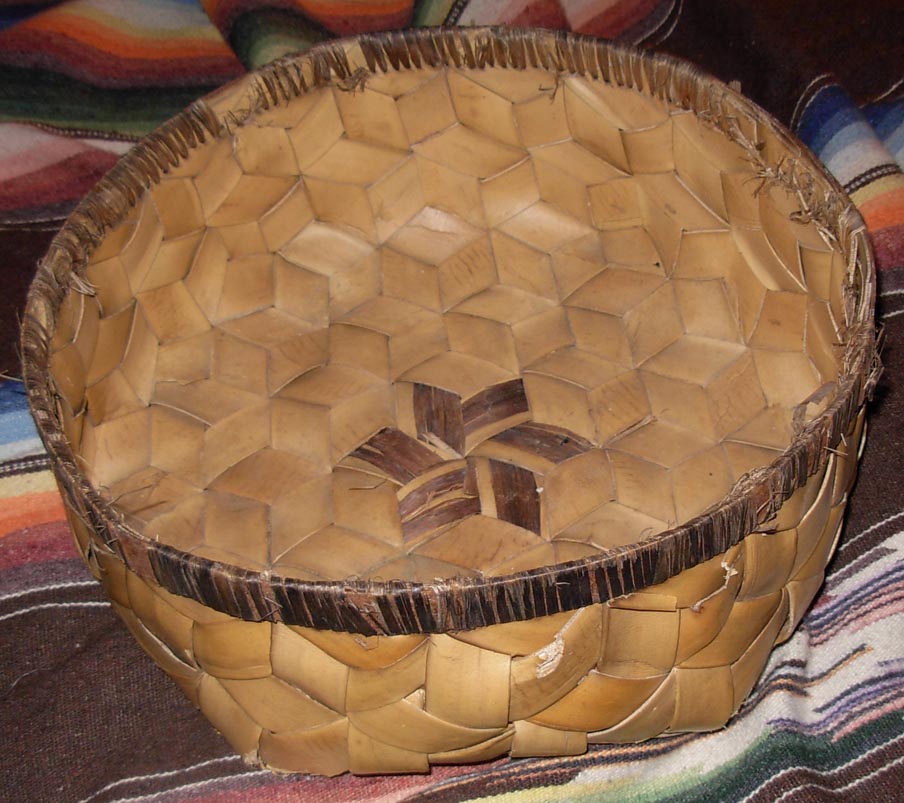
Weavers, Any idea where this basket might be from?

Please help me identify him/her if you can. OK? I’m finding out that it *might* be ash splint or it might be bamboo. And I’m told so far that if it’s North America it might be Cherokee, but I’m also hearing it might be northern New England.

Some are saying the star might be Apache, and others are saying it’s 6 pointed so must be jewish. I’ve tried comparing it with pictures from all over the world but am having no real luck so far.

Any help would be much appreciated.

Thanks a gazillion,
marco

PS: While searching so much; I found a neat “basket” version of the Concentration game, if anyone’s interested; I found it VERY fun!

http://www.nativetech.org/basketry/gameindex.html

10/08/2008

McCain Called Obama “That One Over There.”

Filed under: Academic,News — admin @ 3:14 am

I ranted at angry journalist . com again today.  It’s been a while.

The rest of the corporate media seems to not care
about the fact that Senator McCain is perhaps the
most “under the breath” racist candidate America
has seen since, since, well since it’s beginnings
even.

I challenge people to run this thesis through each and
every filter you’ve got anything to do with.

If I’m wrong, I’d be happy to have that come to pass,
but I’ve been watching him interact with Navajo and
Hopi people and recent immigrants on and off the
camera for years now and it’s really bad.

I’ve seen him not pay attention to African Americans
AT ALL, unless spoken to directly by them, and now
that he’s faced with dealing with one across the
aisle you see the same thing essentially. He refuses
to look at them, and even when he’s spoken directly
to and it’s suggested that he look at him and talk
to him, he’ll look at his left foot and all the verbage
is as if he’s not in the room, and most of it is
directly or supportive of code language!

Is no one picking up on this???

Are people afraid???

I know you’re not dumb. Wake up before it’s too late.

« Newer PostsOlder Posts »

Powered by WordPress